Logical pragmatist
Overview
People with ISTP preferences tend to learn through patient practical use of information and ideas. They’re calm in a crisis and interested in the cause and effect relationships between people, events, and actions. They’re often described as quiet observers.
Characteristics
Strengths

People with ISTP preferences are generally tolerant and flexible, quietly observing the world around them until they see a problem. Then they’ll act quickly to find the right solution.
Here are some common characteristics of people with ISTP preferences:
Adaptable—They’ll change their approach to suit the circumstances around them.
Expedient—You can depend on them to get things done with minimum fuss and maximum efficiency.
Logical—They’re objective in the way they give feedback, approach problems, and make decisions.

Pragmatic—They like to figure out how things work and use them for practical benefits.
Solution-focused—They get to the center of problems, often solving complex issues easily and efficiently.
Interesting facts about ISTPs

ISTPs are deeply focused on facts and logic, but they often start to consider other possibilities—especially as they grow older.
When they feel safe and secure, they tend to consider unique points of view and the possible results of each one. But when they’re under pressure, they’re likely to fall back on logic and eliminate other possibilities.
Hobbies and interests

People with ISTP preferences are often curious and unemotional in their approach to spare time. They usually prefer physical or practical activities that they can do alone or with a friend who shares their interests.

They may enjoy:
Challenging outdoor activities, such as archery, scuba diving, or rappelling.
Building or making things.
Comedy or magic shows.
Video games.
Stretches

Stretches are potential development areas we might miss based on our personality preferences. Awareness of possible stretches or vulnerabilities can be helpful for personal or professional development and improve our relationships with others.

Tap a development area for quick tips from our MBTI<sup>®</sup> experts.
People with ISTP preferences might:
Forget to share their thought process with others.

People with ISTP preferences may find it helpful to make notes or plan what they’re going to say before sharing with others—especially in a group discussion or meeting. This may help them structure their ideas and prepare for questions from others.
Neglect routine tasks to get things done quickly and efficiently.
Know someone who does this? Try asking questions to encourage them to focus on the benefits of routine tasks.
For example, what impact will completing the task have? Will completing a routine task allow them to move on to something they’ll enjoy more?
Move on to new ideas or projects without completing what they’ve started.
Project or time management tools may help people with ISTP preferences meet their goals. They may find it helpful to keep a to-do list or add tasks to an online calendar to help them visualize tasks that are in progress.
Have difficulty seeing how their actions might affect others.

Know someone who does this? It may help them to gather feedback from others who have been affected by their actions in the past. What could they do differently next time?
How others see you

At your best, people tend to see you as calm, tolerant, and quick to respond in a crisis.

Others usually see your:
Realism
Efficiency
Objectivity
You generally share your thoughts only with people you trust or know well. As a result, colleagues may have difficulty understanding or getting to know you.
Those close to you may see you as playful and spontaneous. Others are more likely to think of you as quiet or reserved, unless your reasoning or logic are challenged—then you might surprise them with sudden, assertive outbursts of your views.
Careers

People with ISTP preferences tend to be pragmatic and realistic. They’re very aware of facts and unlikely to be convinced by anything but careful reasoning.
They’ll usually:
Take in information quickly, decide what’s important, and discard anything irrelevant.
Analyze how things work, using their logical approach to solve practical problems.

Prefer to reflect on and understand a situation before they start suggesting solutions.
Focus on practical uses and real-world examples to learn new theories and concepts.
They’re at their best when they can work independently and efficiently. They dislike wasted time or effort, preferring to deal with immediate problems with as little discussion as possible.
Popular occupations

Popular occupations for people with ISTP preferences include:
Technical support
Product designer
Engineer
Firefighter
Police officer
Emergency medical technician (EMT)
Mechanic
Electrician
Manufacturing
Science teacher
Forest services
Career trends

ISTPs are drawn to careers where they can take on hands-on challenges. They like to be directly involved in fixing problems and helping the community, and they prefer to be the go-to person when a problem needs solving.
In many cases, ISTPs prefer careers that are exciting, thrilling, or allow them to work outdoors.
Leadership style

In leadership or management roles, people with ISTP preferences are likely to:
Lead through action and example.
Respond quickly to changing circumstances.
Manage others at a distance without much direct supervision.
Make decisions based on clear, logical principles.
Approach to teamwork

People with ISTP preferences don’t often like to work as part of a team unless there’s an important reason to do so. They may withdraw or become quiet during teamwork and team discussions. They prefer to hash out the details quickly and then set off on their own.
If they do need to work as part of a team, however, ISTPs tend to adapt to the societal norms of group working with respect and kindness.
Problem solving approach
When trying to solve a problem, people with ISTP preferences will usually focus their energy on:
Examining the logical consequences of their actions.
Gathering as many facts and as much information as possible.
They don’t usually spend as much time or energy:
Looking into other possible solutions.
Considering the feelings of the people involved.
Preferred working environment

People with ISTP preferences tend to value:
Action-oriented colleagues.
Independence and autonomy to work in their own way.
A project-oriented and task-focused approach.
Practical experience.
Remote working tips
Remote working tips for people with ISTP preferences:
Allow yourself to enjoy the peace and quiet of working from home.
Share your thought process with others to help them understand your decisions.
Remember to ask for support from others when you need it.
Try to avoid becoming so engrossed by your work that you forget everything else.
Keep in touch with your colleagues. They may appreciate it, even if you don’t always see the need to catch up.
Relationships

ISTPs are typically quiet and reserved. It may be difficult for them to meet friends or potential partners because they tend to shy away from social gatherings. They are more likely to meet people organically, through mutual acquaintances or shared interests.
Conflict

People with ISTP preferences don’t like to get involved in conflict. However, their blunt, matter-of-fact style can sometimes lead to them creating conflict when they don’t mean to. If this happens, they may simply avoid the conflict and carry on.
If there is conflict at work, ISTPs will often stay out of it. They may be unaware it’s even happening.
If you have ISTP preferences, you can minimize conflict in your relationships by:
Apologizing when necessary. Your direct, matter-of-fact approach may mean that you unintentionally hurt someone’s feelings. If this happens, the conflict can often be resolved with a simple, sincere apology.
Considering your words carefully. Try to speak clearly, but with respect and consideration for others. Take care to communicate your ideas without making the other person feel stupid or dismissed.
Presenting a logical resolution in a work situation. If a conflict arises at work that you’re not involved in, you may be able to diffuse the situation with sound logic and a cool head.
Friendship

People with ISTP preferences don’t often need a large group of friends. They prefer to have one or two close, long-term friends. These friendships are usually built around activities and interests, rather than talking about their feelings or what’s going on in their lives.
To their friends, ISTPs are likely to be a loyal, calming presence.
Love

It may be difficult for ISTPs to meet a romantic partner because they tend to prefer being by themselves. They likely need to get out of their comfort zone if they want to meet new people.
In a relationship, ISTPs are loyal, tolerant, and calm—and they often want a partner who shares similar traits. They tend to enjoy quiet relationships with exciting hobbies and shared interests. Because they value their independence, they usually give that same independence to the other person as well.
Parenting

The MBTI framework can be very helpful when it comes to raising children. Knowledge of your own communication habits, stress triggers, and preferences often makes parenting easier. By integrating an awareness of differences into family life, the whole family can benefit from these insights.
Parents with ISTP preferences will likely look for logical solutions to parenting dilemmas and aim to run the household with a calm, steady hand. Their children are likely to feel at ease around them because they present such a calming influence.
ISTPs might feel stressed when their children demand lots of social interaction outside the house, or if they become impatient with simple tasks.
If you have ISTP preferences and you think your child shares your Sensing and Thinking preferences, this can help you to understand how your child takes in information and makes decisions—both of which are important for how you communicate as a parent. If you think your child’s preferences are different than yours, self-awareness will help you to change your communication and parenting style to better suit those preferences.
Stress and resilience

Different people tend to get stressed by different situations. We also tend to react to stress differently.
Here are some of the things people with ISTP preferences may find stressful:
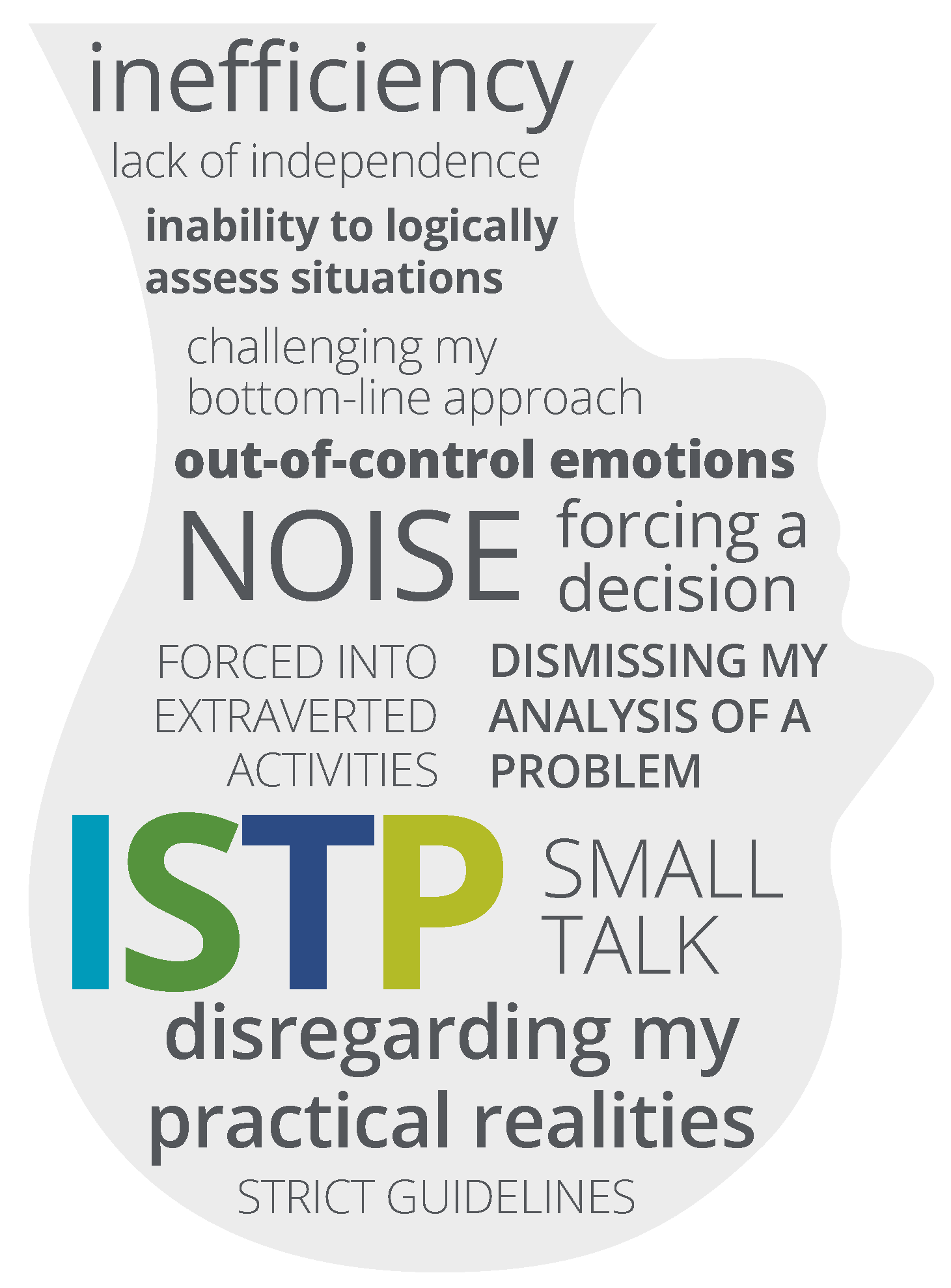
When they’re stressed, people with ISTP preferences are likely to:
Become stubborn.
Seem overcritical of others.
Have difficulty making decisions.

At times of extreme or prolonged stress, they may start to behave uncharacteristically. They might:
Feel alienated from the world around them.
Show sudden and inappropriate outbursts of emotion.
Become oversensitive to what other people think or say about them.
To help someone with ISTP preferences recover from stress, listen to them without judgment. Encourage them to revisit the facts of the situation to look for a different perspective.
Managing stress

If you have ISTP preferences, try these simple strategies to balance your feelings during times of stress:
Create a private workspace where you can easily get into the zone. Make sure others know that you require a calm, quiet place to work in order to produce the best results.
Try to explain your views in a clear, logical way that other people can easily follow. You may find it helpful to make notes to plan what you’re going to say. This will help others understand what you’re saying and make it easier to get them on board with your ideas.
Don’t force yourself to socialize if you’re not feeling up to it. It’s OK to politely decline an offer.
How does ISTP compare?
See how ISTP relates to any other type side by side.
Compare ISTP