Conceptual planner
Overview
People with INTJ preferences are often thought of as masters of long-range strategy. They like to produce innovative solutions to complex problems. They tend to have high standards for themselves and others.
Characteristics
Strengths

Competence and knowledge are usually very important to people with INTJ preferences. They generally set high standards for themselves and others.
Here are some common characteristics of people with INTJ preferences:
Competent—They can be depended on to get things done to the highest standard.
Conceptual—They’re energized by theories and ideas, often exploring a situation from multiple perspectives and finding connections that others might not see.
Objective—They’re logical in the way they give feedback, approach problems, and make decisions.
Independent—They’re comfortable working alone and confident in their insights and decisions.
Strategic—They develop thorough, carefully considered plans in line with their vision for the future.
Interesting facts about INTJs

People with INTJ preferences have strong personalities with a focus on analytical curiosity. This may make it seem like they’re interested in positions of power. However, they rarely take on leadership roles. They often prefer to have full autonomy in their own jobs, rather than control over others.
Hobbies and interests

People with INTJ preferences tend to have a serious and purposeful approach to hobbies. They generally prefer to do things on their own rather than take part in team sports or social events.
Competence and mastery are often important to them. They may be critical of their own performance in leisure activities.

They may enjoy:
Individual physical activities, such as swimming, backpacking, or running marathons.
Visiting museums.
Strategic or knowledge-based board games, such as chess or Trivial Pursuit.
Studying a new subject.
Stretches

Stretches are potential development areas we might miss based on our personality preferences. Awareness of possible stretches or vulnerabilities can be helpful for personal or professional development and improve our relationships with others.

Tap a development area for quick tips from our MBTI<sup>®</sup> experts.
People with INTJ preferences might:
Appear stubborn or uncompromising.

Know someone like this? Encourage them to consider questions or suggestions from others carefully before responding.
Keep their ideas to themselves and expect other people to see things the same way they do.

People with INTJ preferences may find it helpful to share their ideas more often. Involving other people in the planning stages will help to make sure everyone knows what’s expected of them.
Have difficulty letting go of impractical ideas.
Know someone who does this? Try asking questions to encourage them to focus on the available information.
For example, how could they adapt their ideas to match the available information or resources?
Be so task-focused that they forget to pay attention to other people’s contributions.

When they’re working on a project or as part of a team, people with INTJ preferences may find it helpful to focus on how individual contributions help the team get things done or achieve project aims. You can help by reminding them to thank others for their efforts as well as for results.
How others see you

At your best, people tend to see you as calm, decisive, and self-assured. However, you don’t often chat or share personal information with others. As a result, colleagues may feel that they don’t really know you.

Others usually see your:
Innovative focus
Drive to get things done
Perceptive nature
You tend to reflect on situations and ideas to fully understand them before you share or discuss them with others. However, you don’t often explain your thought process or creative insights. Other people might have trouble following your ideas or may be surprised if you seem to change your opinion suddenly.
Careers

People with INTJ preferences tend to be independent, original, visionary, and determined.

They’ll usually:
Develop new and creative strategies for the future.
Enjoy solving difficult problems or learning complicated theories.
Have a natural understanding of how different ideas link together and connect to the overall situation.
Focus on getting things done and achieving their goals as efficiently as possible.
They’re often at their best when they can work independently on long-range strategies or plans. Working with people who are good at what they do is also likely to bring out the best in them.
They’ll probably enjoy thinking about what’s next or considering possibilities for the future.
Popular occupations

Popular occupations for people with INTJ preferences include:
Business consultant
Film director
Lawyer
Writer
Entrepreneur
Engineer
Computer programmer
Web designer
Graphic designer
Hotel or hospitality manager
Career trends

INTJs enjoy career paths that challenge them intellectually and give them a feeling of purpose. They do well when working toward measurable achievements and rewards. INTJs tend to be happy in any career that allows them to analyze a system, understand how it works, and try to make it better.
Leadership style

In leadership or management roles, people with INTJ preferences are likely to:
Motivate others to achieve strategic goals.
Build new systems or processes, reorganizing or removing existing systems when required.
Encourage ideas and innovation.
Take a realistic or tough-minded approach to change.
Approach to teamwork

INTJs enjoy the collaborative, social aspect of being part of a team, but they sometimes struggle to share their ideas or actually work with others. They tend to do best on a team that allows them to discuss how things should be done with clear, honest communication at the start of a project, then go away for a while to complete the work independently.
Problem-solving approach
When trying to solve a problem, people with INTJ preferences will usually focus their energy on:
Creating and exploring possible solutions.
Examining the logical consequences of their actions.
They don’t usually spend as much time or energy:
Considering the feelings of the people involved.
Gathering facts and information.
Preferred working environment

People with INTJ preferences tend to value:
Competent intellectual colleagues.
Independence, autonomy, and privacy.
Opportunities to use their creativity.
An efficient, task-focused approach to their work.
Remote working tips
Remote working tips for people with INTJ preferences:
Develop a daily routine that gives you time to reflect throughout the day.
Allow yourself time to think through the implications of your ideas.
When you think up a new way of doing something, don’t forget to share the idea with others.
In many situations, a video meeting or phone conversation may help you get your message across more easily than an email or IM.
Pay attention to deadlines. Give yourself enough time to consider all the possibilities before you commit to a decision.
Relationships

In their personal relationships, people with INTJ preferences often feel like they need to take care of other people by solving their problems for them. While this isn’t always the case, it is one of the most endearing and admirable aspects of their personalities and is usually met with gratitude from friends and family.
Conflict

INTJs don’t often engage in conflict with others as it can take a lot to make them angry or frustrated. Their direct, matter-of-fact approach means they generally take criticism well and don’t take things personally. However, they may become irritated when other people let their emotions get the better of them and behave irrationally.
If other people are arguing, INTJs may offer their blunt opinions, but they won’t usually interfere or intervene.
If you have INTJ preferences, you can minimize conflict in your relationships by:
Focusing on active listening rather than trying to solve the problem. This may not come naturally to you. Try to remember that sometimes people just need to vent their frustrations.
Keeping your opinions to yourself when others are in conflict. Instead, try offering advice to help others communicate and see each other’s sides of the situation.
Trying not to keep your emotions bottled up when in a conflict. Try to communicate your own emotions calmly and without anger.
Friendship

INTJs are talkative and attentive friends. They listen intently when their friends are talking and will often remember things friends have said in the form of a gift or a recommendation later on.
People with INTJ preferences may come across as too direct or matter-of-fact for some people. To the people they’re close with, though, they are kind, caring, and always willing to help.
Love

People with INTJ preferences are often the caretakers of their relationships. While they may not always communicate their feelings in words, they show them in their actions instead. INTJs are usually the ones to change a light bulb, pick their partner up from work, or encourage their partner to ask for a raise. They also notice patterns in the relationship and try not to make the same mistake twice.
INTJs pride themselves on being loyal and dependable. They aren’t typically all that sociable, but they do enjoy spending a lot of quality time with the person they love.
Parenting

The MBTI framework can be very helpful when it comes to raising children. Knowledge of your own communication habits, stress triggers, and preferences often makes parenting easier. By integrating an awareness of differences into family life, the whole family can benefit from these insights.
Parents with INTJ preferences will likely look for “parenting hacks” and ways to become better parents through trial and error. They often want to improve themselves for their children, who likely appreciate the energy and engagement.
As parents, INTJs are likely to feel stressed when their children behave in an irrational or unpredictable way or can’t move on from a tantrum.
If you have INTJ preferences and you think your child shares your Intuition and Thinking preferences, this can help you to understand how your child takes in information and makes decisions—both of which are important for how you communicate as a parent. If you think your child’s preferences are different than yours, self-awareness will help you to change your communication and parenting style to better suit those preferences.
Stress and resilience

Different people tend to get stressed by different situations. We also tend to react to stress differently.
Here are some of the things people with INTJ preferences may find stressful:
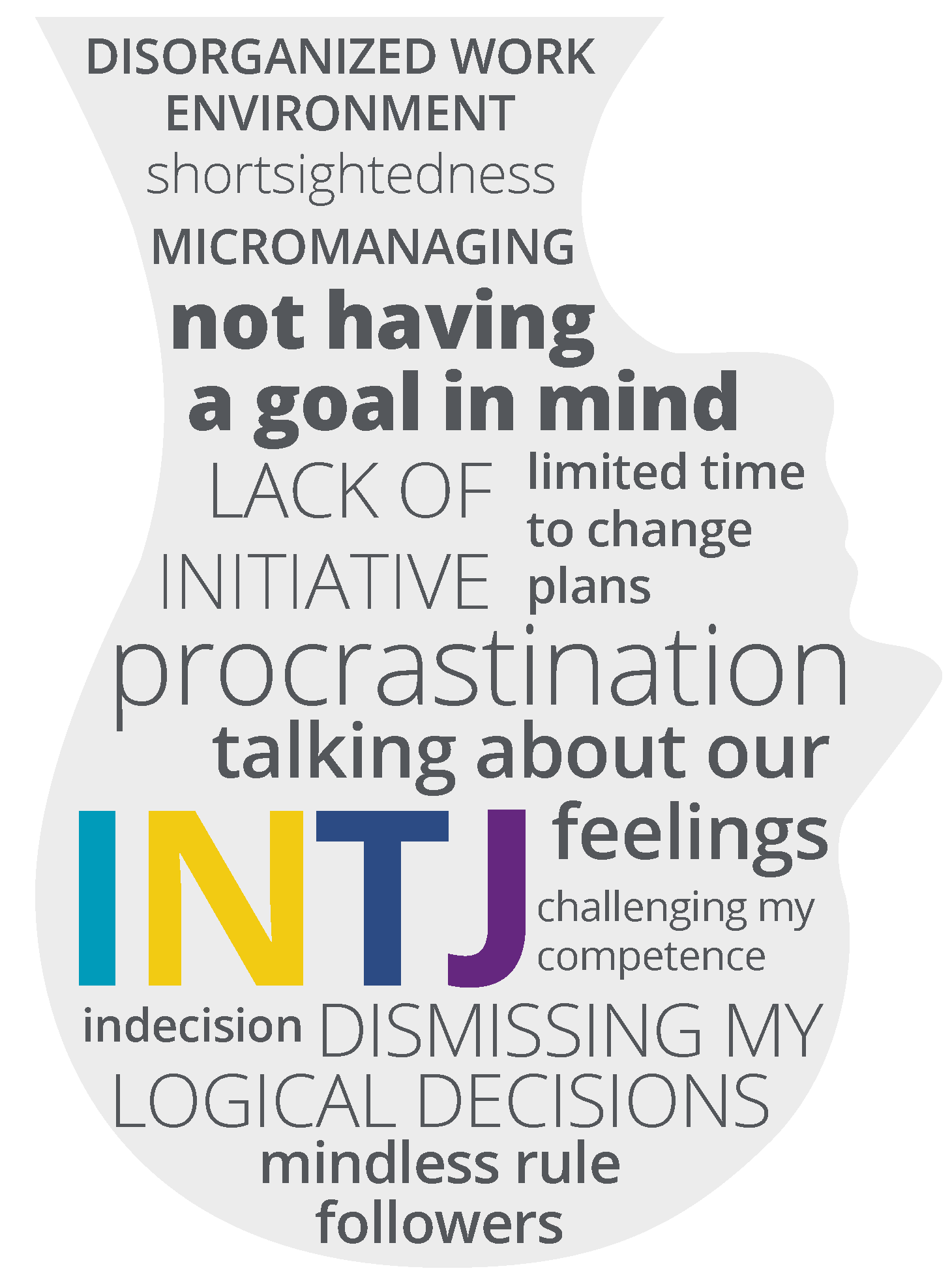
When they’re stressed, people with INTJ preferences are likely to:
See patterns or implications that don’t exist.
Gather too much information or explore too many ideas.
Become stubborn or narrow-minded.

At times of extreme or prolonged stress, they may start to behave uncharacteristically. They might:
Become angry or frustrated with the world around them.
Fixate on details they wouldn’t normally notice.
Overindulge in sensory activities, such as eating or watching TV.
To help someone with INTJ preferences recover from stress, encourage them to spend some time alone to recharge or focus on a task or hobby they enjoy.
Managing stress

If you have INTJ preferences, try these simple strategies to balance your feelings during times of stress:
Ask to define the goals of a project up front when working with others. This way, you’ll always know what you’re working to achieve. This will help you to stay on task and keep the team striving toward the same thing.
Make it your responsibility to create a schedule or allocate jobs for yourself and others. When you’re working with others who don’t require as much structure as you do, this will allow you to create the system you want.
Try to share small, meaningful thoughts and feelings more often. Doing this with the people you care about will likely stop them initiating big conversations about feelings when you least expect it.
How does INTJ compare?
See how INTJ relates to any other type side by side.
Compare INTJ