Energetic problem solver
Overview
People with ESTP preferences motivate others by bringing their energy to every situation. They’re usually easygoing, tend to love life, and are often known for applying their common sense and experience to problems.
Characteristics
Strengths

People with ESTP preferences generally want to have fun. They usually aim to enjoy and experience as much of life as possible.
Here are some common characteristics of people with ESTP preferences:
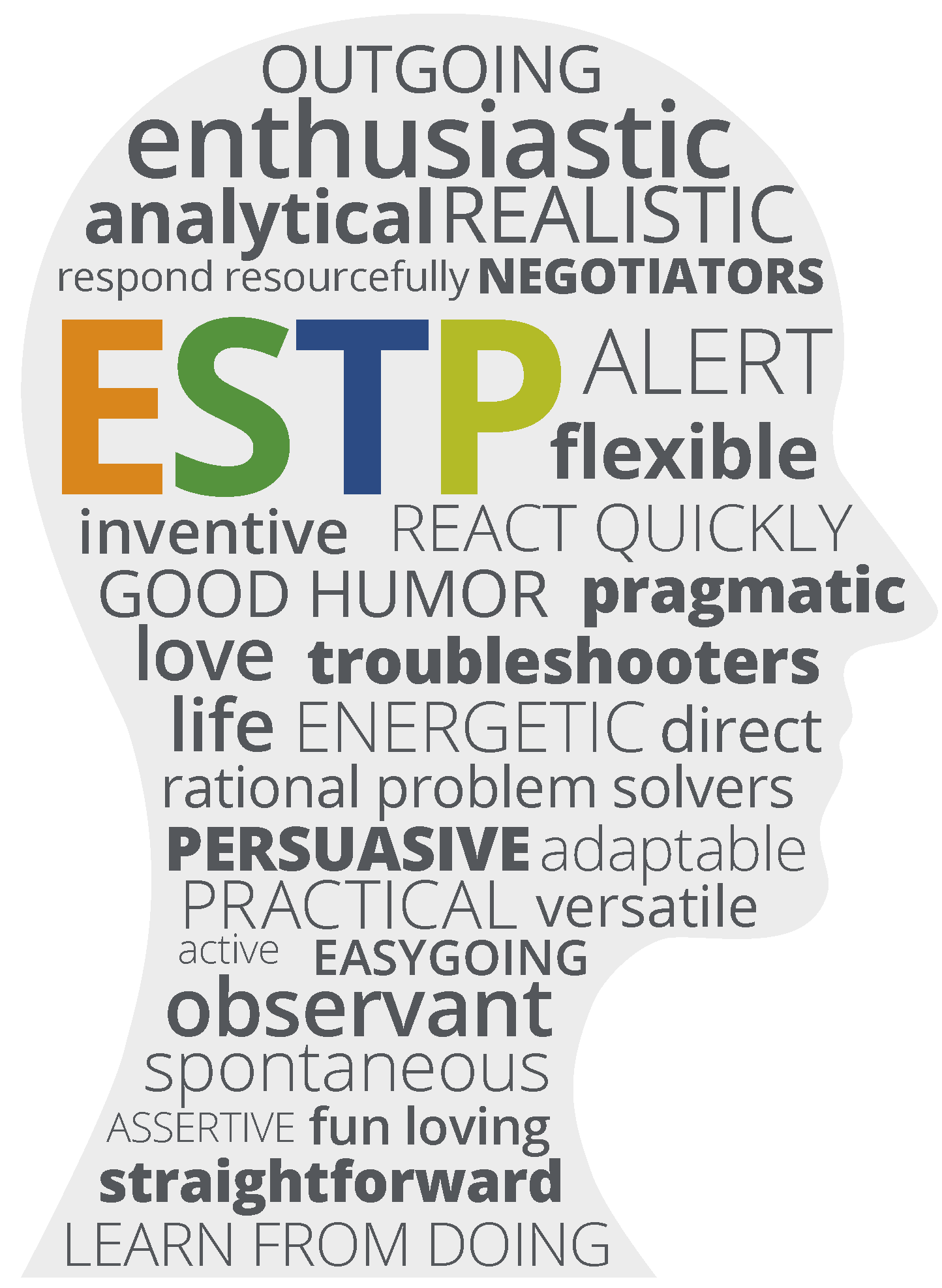
Active—They’re always on the go! They tend to have lots of energy and may get bored easily if they don’t have enough to focus on.
Adaptable—They’re flexible. They’ll change their approach when they need to and look for ways around problems or obstacles as they find them.

Adventurous—They want to experience new things. They enjoy the thrill of physical challenge and they’re comfortable taking risks.
Fun-loving—They don’t take things too seriously. They often try to find ways to make work enjoyable.
Practical—You can count on them to notice what’s happening, react quickly, and get things sorted out, especially in a crisis.
Interesting facts about ESTPs

ESTPs love life. They enjoy spending time with people and being in the moment. This makes them great company for parties, sports events or activities, and work. They’re interested in anything and everything around them.
Hobbies and interests

People with ESTP preferences are highly active and tend to have lots of hobbies. They may like physical activities or team sports more than doing things on their own.

They may enjoy:
Physically demanding activities, such as rock climbing or river swimming.
Challenging sports, such as squash or a triathlon.
Cooking and exploring new flavors.
Hiking or other outdoor activities.
Stretches

Stretches are potential development areas we might miss based on our personality preferences. Awareness of possible stretches or vulnerabilities can be helpful for personal or professional development and improve our relationships with others.

Tap a development area for quick tips from our MBTI<sup>®</sup> experts.
People with ESTP preferences might:
Overlook the long-term consequences of their actions.
Know someone who does this? Try asking questions to encourage them to focus on the future.
For example, how will their decision influence their long-term plans? At work, how might their decision impact on projects, the organization, or their own goals?
Lists or diagrams may also help someone with ESTP preferences organize their thoughts.
Seem insensitive to other people’s feelings when responding to the world around them.

People with ESTP preferences may find it helpful to share their plans with friends and colleagues more often. Involving other people may help to prevent misunderstandings which could affect their relationships. Increased communication would also give other people an opportunity to ask questions or give feedback if they’d like to.
Move on to new ideas or projects without completing what they’ve started.

Project or time management tools may help people with ESTP preferences meet their goals. They may find it helpful to keep a to-do list or add tasks to an online calendar to help them visualize tasks that are in progress.
Have difficulty seeing how their actions will affect others.

Know someone who does this? It may help them to gather feedback from others who have been affected by their actions in the past. What could they do differently next time?
How others see you

At your best, people are likely to think of you as fun-loving and enthusiastic—the spirit of adventure. You’re energized by variety and challenge. You’re usually comfortable trying new activities or taking risks.

Other usually see your:
Easygoing nature
Pragmatism
High energy levels
People tend to notice your liveliness, but they may underestimate the logical analysis you use to make decisions or solve problems. In your hurry to respond to the world around you, you might not share your thought processes with others very often.
Careers

People with ESTP preferences tend to be flexible, adaptable, resourceful, and pragmatic.

They’ll usually:
Learn by doing things, without the need for theory or explanation.
Prefer information and ideas to be communicated in a lively and engaging way.
Analyze data and information quickly to find practical solutions.
Trust their observations of the world around them.
They tend to work best when they can get involved and be spontaneous, taking opportunities as they’re offered. They generally enjoy working with others. In a crisis, they’ll usually respond right away, resolve any issues, and return to normal as quickly as possible.
Popular occupations

Popular occupations for people with ESTP preferences include:
Medical researcher
Manufacturing
Stockbroker
Journalist
Emergency medical technician (EMT)
Police officer
Real estate
Government
Athlete
Actor
Career trends

People with ESTP preferences are often skilled multitaskers. They love to bounce from one task to another looking for results. Because of this, they tend to look for careers that give them autonomy to work at their own pace and on their own schedule.
A traditional nine-to-five office lifestyle may not be suitable for someone with ESTP preferences. If they do have a job with this type of structure, they’ll likely want to create their own way of doing things. Generally, ESTPs look for jobs that offer new challenges every day.
Leadership style


In leadership or management roles, people with ESTP preferences are likely to:
Take charge in a crisis.
Be direct and assertive, easily persuading others to their point of view.
Take the most efficient route to meet their goals.
Seek action and immediate results.
Approach to teamwork

People with ESTP preferences are resourceful workers who like to be where the action is. They love to solve problems and see immediate results. They bring enthusiasm and logic to a team, and often help to create a nonbureaucratic approach.
On a team, ESTPs might frustrate others by improvising too often, taking risks, and jumping in to things too quickly.
Problem-solving approach
When trying to solve a problem, people with ESTP preferences will usually focus their energy on:
Gathering as many facts and as much information as possible.
Examining the logical consequences of their actions.
They don’t usually spend as much time or energy:
Considering the feelings of the people involved.
Looking into other possible solutions.
Preferred working environment

People with ESTP preferences tend to value:
Lively colleagues focused on results and experience.
A flexible approach that allows them to respond to change and work in their own way.
A physically comfortable workplace with up-to-date equipment.
Time to have fun.
Remote working tips
Remote working tips for people with ESTP preferences:
Break up your day with a variety of different tasks.
Between each task, do something to stimulate your senses. Look out the window, go outdoors, or talk to someone online.
Make full use of the added flexibility you get from remote working—but remember that others may not appreciate a late-night email or video call!
Plan to have some time away from interesting distractions each day. Use this time for focused work.
In your leisure time, do something physically active and energetic.
Relationships

People with ESTP preferences may be difficult to get to know. Once you do get to know them—and learn their motivations—they tend to be lots of fun to be around. However, they may be easily distracted by work and life goals.
Although they’re known for being self-reliant, ESTPs enjoy the company of like-minded people. They prefer tight-knit groups of close friends, and relish the freedom to do what they please.
Conflict

In conflict, ESTPs don’t take things too seriously. They tend to laugh things off. This isn’t because they don’t care, but rather because they’re quick to compromise and move on.
When others are in conflict, ESTPs aren’t likely to intervene to try and smooth things over. They will likely voice their opinion and then stay out of the way.
If you have ESTP preferences, you can minimize conflict in your relationships by:
Taking things a bit more seriously if that’s what the other person needs. If you’re in conflict, it’s important for the other person to feel that you’re listened to them.
Trying not to manipulate the other person into ending the conflict. You’re likely very good at reading others. This could give you an advantage when resolving a conflict, but if other people feel that you’re not being authentic, this could backfire and cause further conflict.
Interjecting more to help others resolve conflict. When you see conflict between friends or colleagues, try stepping in to help the different sides understand one another better.
Friendship

People with ESTP preferences are likely to build friendships around shared interests and lifestyles more than emotional connections. They prefer to surround themselves with people who are doing interesting things or people who are motivated the same way they are.
ESTPs have no problem using friendships to make new connections that benefit them professionally. They want to help their friends succeed (and want friends to help them succeed), and don’t see anything wrong in surrounding themselves with like-minded people.
Love

People with ESTP preferences crave autonomy and independence. As a result, they may choose to stay out of serious relationships until they’re ready to commit, preferring instead to date for convenience and companionship without too many strings attached.
Because they’re prone to missing subtle social cues, it can be difficult for ESTPs to tell when a romantic partner is ready to get serious. Being upfront about their expectations may help to avoid uncomfortable conversations later on.
Parenting

The MBTI framework can be very helpful when it comes to raising children. Knowledge of your own communication habits, stress triggers, and preferences often makes parenting easier. By integrating an awareness of differences into family life, the whole family can benefit from these insights.
ESTPs will likely practice an independent parenting style, giving their children the freedom to make their own decisions. They tend to trust their children to learn and grow in their own way. They want their children to become freethinkers who can take care of themselves.
ESTP parents may find it stressful if their children seem too needy or refuse to share issues directly.
If you have ESTP preferences and you think your child shares your Sensing and Thinking preferences, this can help you to understand how your child takes in information and makes decisions—both of which are important for how you communicate as a parent. If you think your child’s preferences are different than yours, self-awareness will help you to change your communication and parenting style to better suit those preferences.
Stress and resilience

Different people tend to get stressed by different situations. We also tend to react to stress differently.
Here are some of the things people with ESTP preferences may find stressful:
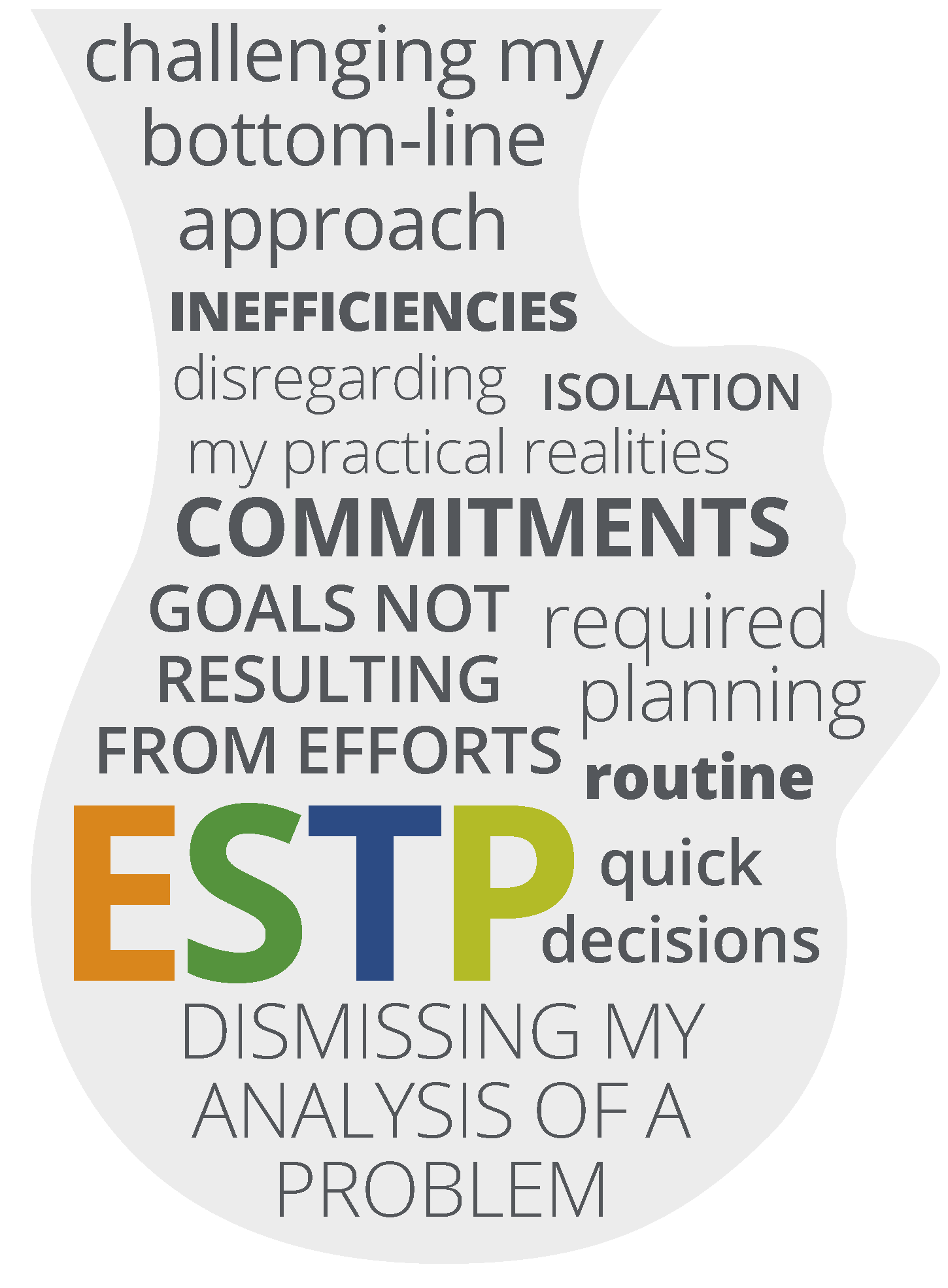
When they’re stressed, people with ESTP preferences are likely to:
Become louder and more active.
Fixate on unimportant or incorrect facts.
Become stubborn or impatient.

At times of extreme or prolonged stress, they may start to behave uncharacteristically. They might:
Withdraw from others.
Catastrophize—imagining increasingly negative possibilities for the future.
Feel marginalized and alone.
To help someone with ESTP preferences recover from stress, encourage them to stop what they’re doing and do something active that they enjoy. Try to stay positive—you may be able to help them plan their next steps.
Managing stress

If you have ESTP preferences, try these simple strategies to balance your feelings during times of stress:
Pay attention subtle or nonverbal communication from others. While you tend to communicate directly and don’t shy away from confrontation, others may be less direct. Look out for this both at work and in your personal relationships.
Avoid putting yourself in situations where others might micromanage you or impose lots of deadlines on your work. People with ESTP preferences tend to thrive in situations that provide the freedom to experiment. It may be difficult to avoid these stressors in a traditional or hierarchical work setting.
Consider ways to ask other people for things without manipulating or coercing them. While it’s OK to observe others to best understand what motivates them, you may irritate friends and colleagues if it seems like you’re using them.
How does ESTP compare?
See how ESTP relates to any other type side by side.
Compare ESTP