Decisive strategist
Overview
People with ENTJ preferences tend to think strategically about the future. They like to organize people and resources efficiently to accomplish long-term goals. They’re objective and critical in their decision-making and are often comfortable in leadership or management roles.
Characteristics
Strengths

Competence and intelligence are usually very important to people with ENTJ preferences. They tend to enjoy interacting with knowledgeable people and discussing or debating ideas.
Here are some common characteristics of people with ENTJ preferences:
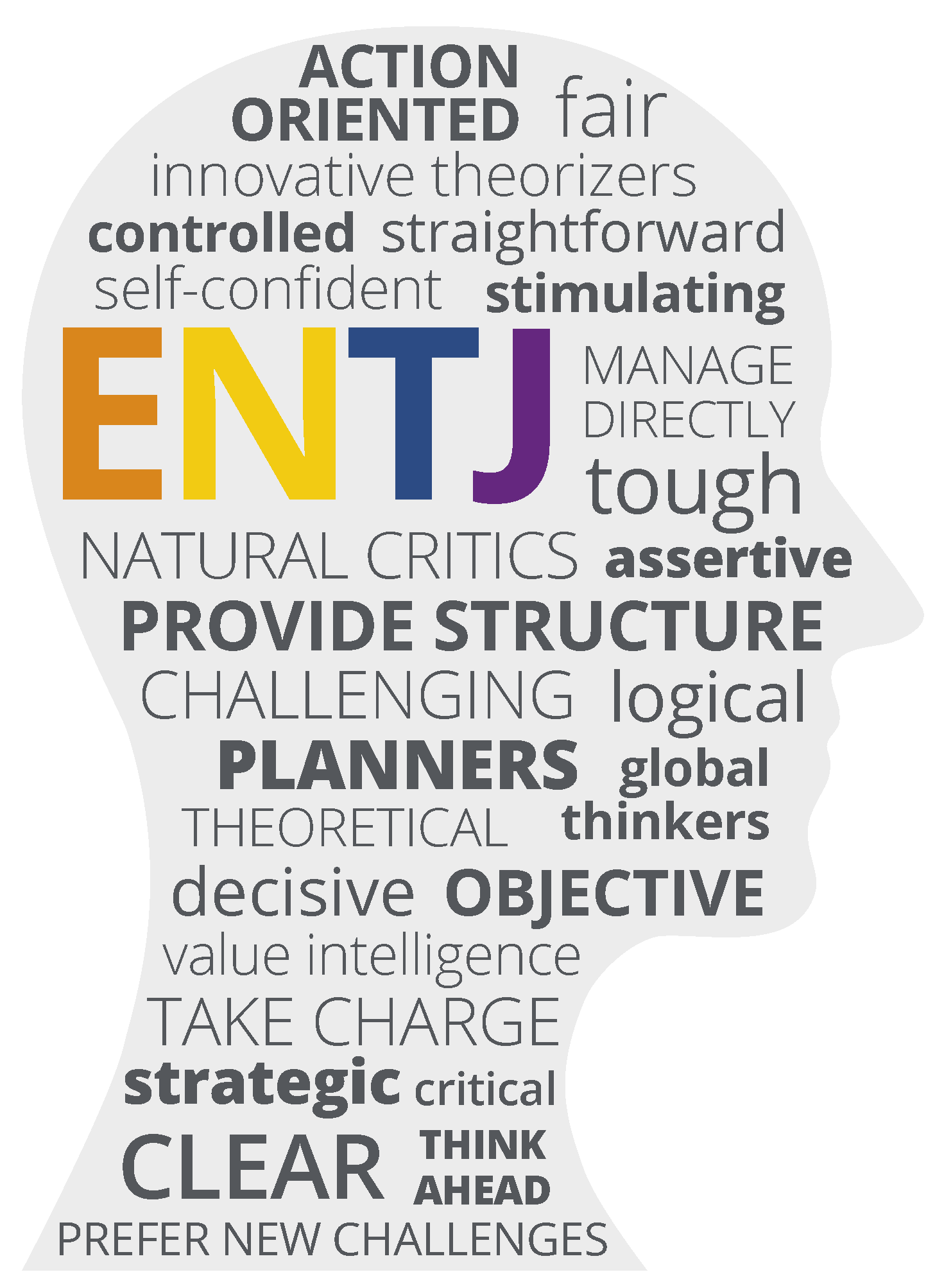
Assertive—They clearly express their views and communicate strategies for what needs to be done.

Competent—You can depend on them to do things to the highest standard.
Challenging—They ask difficult questions to find out what’s wrong with a situation so that they can correct and improve it.
Logical—They’re objective in the way they explain things, give feedback, approach problems, and make decisions.
Strategic—They develop thorough, well-considered plans in line with their vision for the future.
Interesting facts about ENTJs

People with ENTJ preferences are comparatively rare. Less than 2% of people in the global sample report ENTJ preferences—the second lowest percentage of the 16 Myers-Briggs® types.
ENTJs are truly unique individuals with very strong personalities which may, at times, seem contradictory. They’re often both personable and goal oriented; both inspired by others and highly analytical.
Hobbies and interests

People with ENTJ preferences generally take a structured approach to spare time. They may find it difficult to relax or play until they feel that their work is completed.
When they do take part in leisure activities, they tend to take an enthusiastic and outgoing approach, often leading or organizing others.

They may enjoy:
Competitive or skilled sports, such as squash, cycling, or golf.
Learning a new skill or reading about something new and intriguing.
Strategic or knowledge-based board games, such as chess or Trivial Pursuit.
Community or sporting events.
Stretches

Stretches are potential development areas we might miss based on our personality preferences. Awareness of possible stretches or vulnerabilities can be helpful for personal or professional development and improve our relationships with others.

Tap a development area for quick tips from our MBTI<sup>®</sup> experts.
People with ENTJ preferences might:
Neglect their own feelings or overlook the feelings of others when working on a project.

Meditation or other mindfulness techniques may help people with ENTJ preferences stop and notice their own feelings more often.
When they need to make a decision that’s likely to affect other people, encourage them to talk to the people involved. This will increase their awareness of the feelings of others before they commit to a course of action.
Be so task-focused that they forget to pay attention to other people’s contributions.

When they’re working on a project or as part of a team, people with ENTJ preferences may find it helpful to focus on how individual contributions help the team get things done or achieve project aims. You can help by reminding them to thank others for their efforts as well as for results.
Have difficulty adapting their approach to a changing situation.

Know someone who does this? Try asking questions to encourage them to focus on the available information.
For example, how could they adapt their ideas to match the available information or resources?
Make decisions too quickly and put pressure on others to do the same.

Know someone who does this? Try suggesting a results-focused approach. Although others may approach a decision differently and reach a decision more slowly, they might get similar—or even better—results.
How others see you

At your best, you’re likely to be seen as energetic and determined. You often take charge of the situation around you—as a result, others may think of you as a capable leader.

Others are likely to see your:
Decisiveness
Drive to explore and discuss ideas
Objective approach
You communicate clearly and articulately, asking challenging questions to check your understanding. When sharing your vision or ideas that are important to you, you’re likely to do so with conviction that others may find inspiring.
Careers

People with ENTJ preferences tend to be logical, organized, and decisive.

They’ll usually:
Prefer to create order where possible, taking a systematic approach to problem-solving.
Develop long-term strategies in line with their vision and direct other people to achieve the goals they’ve set.
Focus their attention on the future, finding and implementing changes to improve the world around them.
Notice inefficiencies or logical flaws in other people’s work and try to correct them.
They work best in an organized environment. They often want to learn new skills and expand their knowledge—which they also enjoy sharing with others.
Popular occupations

Popular occupations for people with ENTJ preferences include:
Management
Coach
College or university teacher
FBI or other intelligence agencies
Criminal justice
Entrepreneur
Business executive
Engineer
Sales and marketing
Program manager
Career trends

ENTJs are incredibly driven and tend to focus on success at work, either in their own careers or on team projects. They are often best suited to careers that allow for long-term planning and execution, such as creating conceptual models or establishing plans for others to follow.
One valuable characteristic of ENTJs is their willingness to take responsibility for difficult decisions. This is a cornerstone of many well-suited careers for people with ENTJ preferences.
Leadership style

In leadership or management roles, people with ENTJ preferences are likely to:
Take an action-oriented, energetic approach.
Manage people and projects directly, making tough decisions when they need to.
Enjoy making long-term plans and solving complex problems.
Want to control as much of the organization possible.
Approach to teamwork

As part of a team, ENTJs use their laser focus to find the solution to any problem. They’ll often communicate their ideas clearly and concisely—and they’re usually so confident in their own thought process that it makes others feel confident, too.
ENTJs may cause conflict if they ignore other team member’s opinions or refuse to listen to counterpoints in a discussion. In general, though, they’re a valuable part of any team, providing an analytical mind to balance the more creative, conceptual ideas of others.
Problem-solving approach
When trying to solve a problem, people with ENTJ preferences will usually focus their energy on:
Examining the logical consequences of their actions.
Creating and exploring possible solutions.
They don’t usually spend as much time or energy:
Gathering facts and information.
Considering the feelings of the people involved.
Preferred working environment

At work, people with ENTJ preferences tend to value:
Efficiency and structure.
Independent, competent colleagues.
A goal-oriented approach that rewards decisive action.
Challenging opportunities.
Remote working tips
Remote working tips for people with ENTJ preferences:
Pay attention to specific details when making and implementing plans.
Working from home can help you be more productive, but take care not to push decisions through without seeking the views and opinions of others.
It can be difficult to pick up on social cues in online meetings. Give everyone a chance to speak and use video if possible.
Try not to be too directive online. Maintain a balance between directing and listening.
Check emails or other written communications before you send them. This is especially important if you’re stressed or in a hurry.
Relationships

People with ENTJ preferences are stimulated by interesting conversation and intellectual debate with their friends, family members, and romantic partners, They tend to treat the people they care about fairly and directly. They don’t tend to be highly emotional, so they probably won’t express their feelings all the time.
ENTJs feel most confident when they’re able to make a clear decision. When they choose a friend or partner, they’re showing that person how important they are.
Conflict

ENTJs may run into conflict if they are too direct or disregard other people’s feelings when they’re communicating their thoughts or opinions.
In a conflict, ENTJs will likely want to find a quick, clear-cut, and logical resolution. They’re often good at keeping things objective and resolving issues with fairness, but may need to remind themselves to listen to both sides of an argument.
If you have ENTJ preferences, you can minimize conflict in your relationships by:
Listening carefully to the other person’s point of view before you jump to a resolution. This may help you to solve the underlying problem, instead of simply ending the conflict.
Reminding yourself that other people’s emotions are valid. Take care that you don’t just combat emotions with facts and figures.
Setting aside your drive to succeed. Although it may not come naturally, take some time to consider the more human, nuanced aspects of the relationship before you try to move forward.
Friendship

As friends, ENTJs are personable and engaged. They often bond with others over shared interests and hobbies.
They tend to value friends who avoid drama, but they’re more than happy to offer stimulating conversation and debate. When it comes to making plans or organizing trips, they’re usually the logical planners.
While they’re unlikely to offer emotional comfort in a crisis, ENTJs are quick to jump in and solve problems to help a friend in need.
Love

ENTJs tend to value romantic partners who are logical and kind above all else. Because of their analytical nature, they’re likely to search for someone who can make them feel peaceful and intellectually stimulated.
Although ENTJs may struggle to understand extreme emotions in others, they generally want to take care of their partners. They tend to do best in relationships with partners who balance their goal-oriented lifestyle.
Parenting

The MBTI framework can be very helpful when it comes to raising children. Knowledge of your own communication habits, stress triggers, and preferences often makes parenting easier. By integrating an awareness of differences into family life, the whole family can benefit from these insights.
People with ENTJ preferences tend to take a calm and pragmatic approach to parenting. They guide their children with logic and intellect, encouraging them to use sound reasoning when making decisions. They often foster both creativity and curiosity in children, which they see as preparing them to excel later in life.
As parents, ENTJs may find it stressful to handle the typically extreme emotions of children.
If you have ENTJ preferences and you think your child shares your Intuition and Thinking preferences, this can help you to understand how your child takes in information and makes decisions—both of which are important for how you communicate as a parent. If you think your child’s preferences are different than yours, self-awareness will help you to change your communication and parenting style to better suit those preferences.
Stress and resilience

Different people tend to get stressed by different situations. We also tend to react to stress differently.
Here are some of the things that people with ENTJ preferences may find stressful:
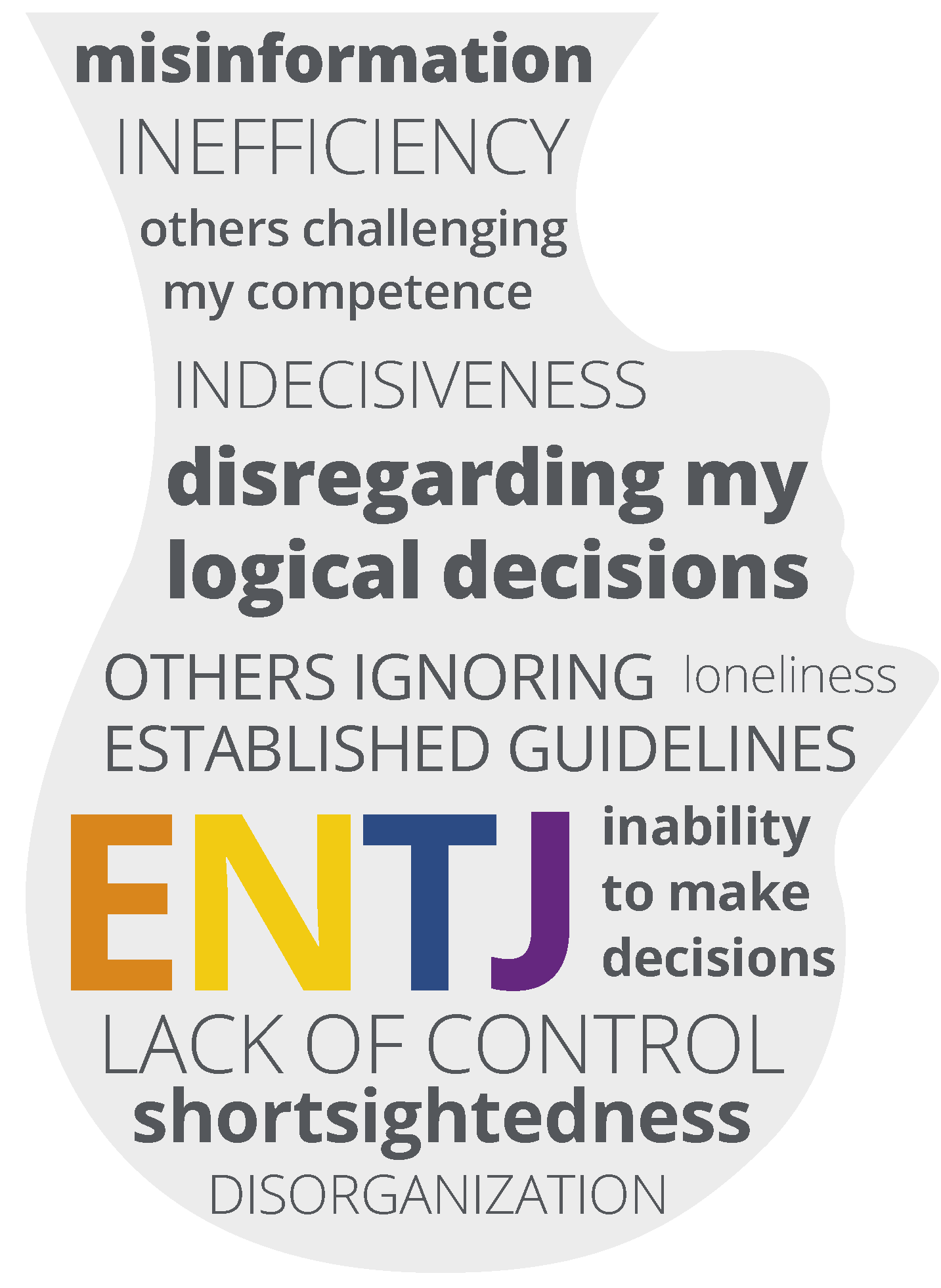
When they’re stressed, they’re likely to:
Become bossy or inflexible.
Criticize themselves or others.
Communicate in an aggressive or impersonal way.

At times of extreme or prolonged stress, they may start to behave uncharacteristically. They might:
Feel alone or unappreciated.
Become convinced of their own incompetence.
Have difficulty communicating their thoughts or ideas to others.
To help someone with ENTJ preferences recover from stress, listen to them without judgment and encourage them to focus on what’s achievable.
Managing stress

If you have ENTJ preferences, try these simple strategies to balance your feelings during times of stress:
Learn to identify the areas of a situation that are within your control, and those that aren’t. Focus your attention on the things you have direct control over.
Listen to the opinions of others and take a moment to consider the validity of their points of view. Other people might know more than you on a particular subject, and their expertise may help you to make the right decision.
When someone seems to question your decision, pause for a moment. Don’t react immediately (you’ll probably react badly if you do). Instead, consider whether your decision could be improved. If you can’t see room for improvement, think about how best to explain your reasoning to others.
How does ENTJ compare?
See how ENTJ relates to any other type side by side.
Compare ENTJ